The Tatami and the Boardroom: What Accompanying Aikido's Doshu Taught Me About High-Stakes Business
In 1978, aged seven, I began Aikido at Hombu Dojo. In 2016, my wife and I spent a week as personal interpreters for Doshu Moriteru Ueshiba in France. What the mat taught me about leading under intense pressure in enterprise business.
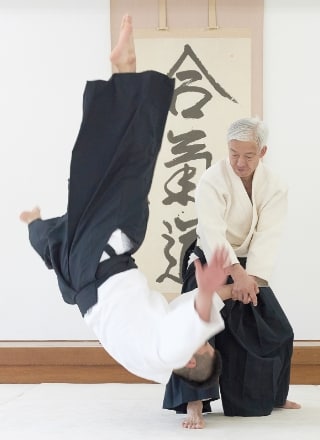
Dōshu Moriteru Ueshiba demonstrating at Aikikai Hombu Dojo, Tokyo. Photo courtesy of Aikikai Foundation.
Cet article est également disponible en français : Lire en français
Most people believe high-stakes negotiation is combat. You build an armor of arguments, brace for the counter-attack, and push until someone yields.
In September 1978, on the tatami of Aikido's world headquarters in Tokyo, my father and an instructor named Shibata Sensei (who, to my seven-year-old eyes, seemed like an ancient authority) started teaching me the exact opposite.
I was seven years old. Shortly after we unpacked in Kagurazaka, my father sat my brother and me down. He asked if we wanted to practice Aikido, but he made us promise that if we stepped into the dojo, it would be a serious, long-term commitment, not a passing hobby. We agreed.
That decision put us in the children's section of the Hombu Dojo in Shinjuku. For the six years that followed, we trained several times a week. I went on to practice for more than fifteen years, carrying the discipline through Morocco, France, and back to Tokyo.
Thirty-eight years after that first bow, a phone call brought that commitment full circle in a way I could never have imagined.
The Pro Bono Week
In the spring of 2016, the French Federation of Aikido and Budo (FFAB) contacted my wife and me. They were organizing an international seminar in Provence in tribute to Master Nobuyoshi Tamura. The invitation had its roots the previous autumn, when the federation asked me to translate an exclusive interview with Doshu at Hombu Dojo in Tokyo ahead of the memorial.
Now, the guest of honor was arriving in France. Doshu Moriteru Ueshiba, the third hereditary world leader of Aikido and grandson of its founder, Morihei Ueshiba, was visiting with Madame Ueshiba, who was traveling to France for the very first time.
The federation needed personal interpreters to accompany Doshu and his wife around the clock, from their departure gate at Tokyo airport to their return flight a week later.
There was only one catch on my side: I had just started a new job at Red Hat. Asking your brand-new manager for a week off right after walking through the door to do unpaid volunteer work is not standard corporate protocol. I went to him, laid out what the role meant, and asked for his blessing.
He didn't hesitate for a second. He told me it was a once-in-a-lifetime opportunity to be in direct, personal contact with someone of Doshu's stature, and told me to go.
1,000 Square Meters in a Provence Heatwave
The scale of what the Provence league put together was staggering. In the Gymnase de Verdun in Pertuis, they laid out 1,000 square meters of tatami.
That Saturday afternoon, in the middle of a searing Provence heatwave with the gymnasium doors wide open, more than 1,000 practitioners from fifteen countries crowded onto the mat at once. In the morning there had been 700; the next day there would be another 600.
My role was to translate back and forth between Doshu and the practitioners during demonstrations, handle recorded interviews with television crews and print journalists, and translate speeches at civic receptions with local mayors and parliamentarians.
The responsibility was heavy. Translating on a tatami isn't just swapping vocabulary. It requires understanding the context, the nuance, and the spirit behind the words. Having trained in Aikido for fifteen years gave me that vocabulary, but standing beside Doshu under bright lights and intense scrutiny was an undeniable test of nerves.
Meanwhile, my wife played an indispensable role alongside Madame Ueshiba. For someone visiting France for the first time, unfamiliar with the language and the customs, an overseas trip of that magnitude can easily become overwhelming. She made sure Madame Ueshiba felt cherished, comfortable, and completely at ease from morning until night.
Our mission was simple: to provide a protective bubble, a safety net so that neither Doshu nor his wife would ever feel isolated or stressed, in any situation.
Through that week of 24-hour proximity, sharing quiet drives through the Luberon as well as crowded ceremonies, we built a genuine personal bond with both of them that we treasure to this day.
It also gave me something rare: a glimpse of the man behind the public mantle. Doshu carries an immense, formal responsibility as the living symbol of Aikido worldwide. Yet behind that omote (the formal public face), he is a remarkably simple, humble, and grounded person.
The Martial Paradox: Concentrated Yet Detached
How does someone handle that level of pressure without freezing or burning out?
On the tatami, Aikido simulates life-or-death situations. Under attack, human instinct tells you to brace and lock your muscles. Aikido trains you to do the reverse: release the tension, keep your breath (kokyu) flowing, and let a strong, quiet core absorb and guide the momentum.
In classical Budo, this discipline is captured by Dōchūsei (動中静): quietness in turmoil. It is the ability to maintain complete internal calm and clarity of mind while remaining in continuous, fluid motion.
Watching Doshu, and stepping onto that mat to translate for him, reinforced that fundamental paradox:
To perform at your highest level under intense pressure, you have to be simultaneously intensely concentrated and completely detached.
It sounds like a contradiction, but detachment does not mean walking away from accountability. It means detaching from your ego: releasing the personal need to win, the impulse to defend yourself, and the anxiety surrounding the outcome. That posture rests on two distinct disciplines:
- Dissociating your person from your role: You must keep an internal distance between the chaos of what is happening around you and who you are at your core. In high-stakes representation, you inhabit the role fully without letting your personal self-worth become hostage to the room.
- Harmonizing your energy (Ai-ki): The goal is to harmonize your ki with the environment's ki. When you do that, you are never in opposition or collision with the world around you. You don't resist the room; you move with it.
Bringing the Tatami to the Boardroom
In enterprise sales and executive leadership, high-stakes negotiations feel surprisingly close to those simulated life-or-death moments on the tatami.
When you are managing a complex enterprise contract, coordinating dozens of stakeholders across multiple time zones, or watching a critical deal stall in the final hours of the quarter, the temptation is always the same: to fight.
In corporate culture, especially in Japan, there is a deep respect for 我慢 (gaman): gritting your teeth, absorbing the pressure, and soldiering on. But as a leader, absorbing pressure like a sponge is a trap. Eventually you burn out, and the anxiety you think you're hiding inevitably leaks into your team.
Aikido offers an alternative posture. From that practice, I carry three habits into business:
1. Receive Without Absorbing (受け流す: Ukenagasu)
In Aikido, you never meet force head-on. When someone attacks or pushes with intense force, human instinct is either to brace and fight back, or to collapse. Ukenagasu is the third path: through tai-sabaki (body movement), you step off the line of force, allow their momentum to pass harmlessly into empty space, and maintain your own balance. By refusing to supply the friction they expect, you deny aggression its effect.
In a negotiation, when an aggressive demand or hostile objection arrives, do not absorb it into your gut. Let the pressure pass through you while keeping your center and your control.
2. There Is No Enemy (合気: Aiki)
In Aikido, the person attacking you is not an enemy. They are a partner whose energy you must blend with.
On the mat, this is the physical reality of irimi-tenkan (entering and pivoting): instead of clashing chest-to-chest, you step in and turn so you are standing shoulder-to-shoulder, looking in the exact same direction they are looking. You don't fight their momentum; you guide it.
Tsuki Kote-gaeshi demonstrated by Mitsuteru Ueshiba, Director of Aikido Hombu Dojo. Watch the full demonstration on YouTube ↗
In negotiations, the customer pushing back on pricing or threatening to halt discussions is not trying to destroy you. They have constraints, internal pressures, and fears of their own. When you shift your mindset from "how do I beat this objection" to "how do we look in the same direction to solve this together," the dynamic changes completely. It is not a fight; it is collaboration.
3. Move Decisively (動く: Ugoku)
Receiving and redirecting pressure is not passivity. The moment the energy has passed by, you take decisive action. On a deal, that means immediately proposing the revised commercial terms, restructuring the timeline, or designing the concrete workaround that allows both sides to move forward.
Detaching From the Numbers
When you walk into a boardroom to negotiate a pivotal agreement, you need to know your facts cold. But you also need to detach yourself from the numbers.
If you are obsessed with the commission, the target, or the quarterly deadline, the other side feels that desperation instantly. You become rigid, and rigidity breaks under pressure.
Detachment does not mean you don't care. It means your foundation is rooted in something deeper than the immediate transaction:
- Creating genuine value for the people across the table.
- Protecting the energy and psychological safety of the team behind you.
- Knowing who you are when the meeting ends, regardless of the outcome.
That seven-year-old boy bowing onto the tatami at Hombu Dojo in 1978 didn't know anything about enterprise software, global accounts, or multi-million-dollar contracts.
Yet nearly five decades later, when the stakes are at their peak and the entire room is tense, the discipline is identical.
You don't brace. You don't fight the current. You release the tension, let the breath move through your core, and step alongside the person across from you.
True authority doesn't come from forcing someone to submit. It comes from finding a path forward where, in the end, the other party thanks you.